Book Reviews 11
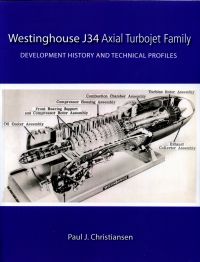 |
Westinghouse J34 Axial Turbojet Family
Development History and Technical Profiles
by Paul J. Christiansen
Softbound, 8.5" x 11.0" x 1.0", 396 pages
ISBN-13: 979-8321247204
Bleeg Publishing LLC (2024)
Recommended Retail Price: $44.59
197 Photos and Figures
|
Reviewed by Kimble D. McCutcheon - 8 Nov 2024
Westinghouse J34 Axial Turbojet Family is a fitting culmination of Paul Christiansen’s brilliantly detailed five-book series on Westinghouse aircraft gas turbines. The J34 (Westinghouse designation X24C) was Westinghouse’s most successful engine, finding wide application in numerous aircraft types including the Convair F2Y, Curtiss-Wright XF-87, Douglas D-558-2, Douglas F3D, X-3, Fairchild C-119, Grumman OV-1A, Lockheed P-2E/G/H, McDonnell F2H, McDonnell XF-85, McDonnell XF-88, North American T-2A, Ryan XFR-4, Vought F6U and Vought F7U.
Christiansen begins his J34 story with brief coverage of the Westinghouse X19A and X19B, engines that helped establish the technological base from which the J34 grew. While the X24 was not a direct descendant, many of its features addressed shortcomings in the X19 design, most notably its relatively low thrust. When the U.S. Navy’s Bureau of Aeronautics (BuAer) requested a higher-thrust X19 variant, Westinghouse proposed 21”, 23” and 24” diameter designs designated the X21C, X23C and X24C, with the X24C designation first appearing in 6 Jun 1944 proposal amendment.
The X24C endured the usual new-engine teething problems, but its development was severely impacted by the Navy’s request for myriad variations, including different tail pipe/nozzle/emergency fuel system configurations for every airframe application, and accessory locations on the engine’s port, starboard or bottom sides. The Navy finally wised up and reduced the configuration combinations to a manageable level. This led to X24C-series production with its initial 3,000 lbT takeoff rating. On 15 Jan 1947 the Army Air Materiel Command (AMC) Engineering Standards Section assigned J34-WE-1, -3, -5, -7, -9 designations to Army engines; the Navy later adopted this same designation convention for its engines.
With its history and initial development covered, Christiansen devotes a chapter to J34-WE-22 production, which includes coverage of the numerous issues that arose when AMC insisted on multiple sources for its engines. Allison and Wright Aeronautical were selected as J34 second sources, but protracted arguments among the AMC, BuAer, Westinghouse, Allison and Wright Aero over drawing quality, drawing revision control and general engine configuration control persisted so long that the requirement for J34 second sources was dropped and neither Allison nor Wright Aero produced any engines.
Christiansen provides other development and production chapters for the following models: J34-WE-30, -30A and -40; J34-WE-11; J34-WE-28 and 34; J34-WE-36; J34-WE-32, (-17, -42), -38; and J34-WE-46, -48.
Chapter 15 is a deep dive into J34 construction and operation. An appendix lists all J34 model numbers and their respective characteristics; another appendix is a reprint of Federal Aviation Administration Type Certificate Data Sheet No. E-265, which documents Westinghouse’s attempt to penetrate the commercial jet engine market.
This book, along with its predecessors, presents a detailed look at the development of a technology as engine manufacturers and their government customers came to grips with the complexities of engine and airframe requirements definition, specification, design, development, construction, production and use.
 |
L-15 Scout
Boeing's Smallest Airplane
by Mal Holcomb
Softbound, 7" x 10" x 0.52", 260 pages
Print ISBN: 978-1-4766-9285-2
E-book ISBN: 978-1-4766-5069-2
McFarland & Company (2024)
Recommended Retail Price: $39.95
183 photos
|
Reviewed Kimble D. McCutcheon – 12 Nov 2024
At WWII’s end American aviation manufacturers faced massive layoffs when Government contracts were canceled. Many thought returning veterans would be a huge market for small aircraft. That is why there are so many 1946 Aeroncas, Luscombes, Pipers, and Taylorcrafts still around. Beechcraft and Mooney also took advantage of this post-war aviation enthusiasm.
Big-airplane builders wanted in on the action as well; Convair designed the Model 118 ConvAirCar; Douglas designed the Model 1015 Cloudster II; Grumman designed the G63 Kitten and G72 Kitten II; Lockheed designed the Model 33 Little Dipper and Model 34 Big Dipper; North American designed the NA-145 Navion. None of these made any money and only the Navion got past the prototype stage; its production was ultimately taken over by Ryan, which with its lower overhead, was barely able to break even.
Boeing took a different path and bid on a Field Artillery Observation (liaison) Aircraft in 1946; Boeing also hoped this design would be attractive to the general aviation market. Although Boeing’s L-15 did not win the competition, the Government, wanting to keep the Boeing plant Wichita, Kansas, open for upcoming Boeing B-47 production, gave Boeing a contract for the L-15 anyway.
AEHS Member Mal Holcomb, a retired aeronautical engineer with extensive experience in general aviation aerodynamics, aircraft design, and flight testing and has written an outstanding, thoughtful, informed and detailed account of the Boeing L-15 story. In addition to covering the post-WWII U.S. aviation environment, Holcomb provides in-depth coverage of the following:
- Boeing’s Entry in the Liaison Aircraft Competition
- The XL-15 Design
- Testing and Development
- Performance
- The Airframe
- Propulsion
- Landing Gear Design and Development
- Systems and Weights
- Ground Handling and Maintenance
- Pilot Comments
- Accelerated Service Tests
- Army and Air Force Politics that Arose During XL-15 Development
- Boeing’s L-15 Follow-on Concepts
This book nicely documents what has until now been a rather obscure aircraft. I highly recommend it.